
Traditional eLearning
- Information slides and quizzes
- Tests recall of facts
- Correct or incorrect feedback
- Passive consumption
- Completed once, then forgotten
Why simulations?
Simulations let learners practice real decisions in a risk-free environment. They build confidence, improve retention, and create data you can actually use.
The shift
Use your existing courses for knowledge. Add simulations when learners need to apply it.
Simulations do not replace your eLearning stack. They make it useful at the point where knowledge turns into behavior.
The 3C framework
Challenge. Choice. Consequence. Get these right and the learning does not feel like a quiz.
A realistic situation the learner could face at work: a customer complaint, safety incident, difficult conversation, or ethical gray area.
Example: A candidate leaves sensitive notes on the desk during an interview. What do you do?
A decision that feels plausible. Good choices are not cartoonishly right or wrong; they carry trade-offs.
Example: Read the notes, wait patiently, or ask about them when the interviewer returns?
The natural outcome of the decision. Not a scolding feedback box, but a result the learner can interpret.
Example: The interviewer notices the notes moved, and the tone of the conversation changes.
The business case
Practice is cheaper than mistakes, faster than custom roleplay, and easier to measure than classroom discussion.
faster development than the old custom-production model
average engagement lift when learners make decisions
better 30-day retention for practice-led learning
return on high-stakes skills programs when practice scales
Seamless integration
Add BranchTrack at the practice stage, after learners have the knowledge and before they use it on the job.
Use your existing eLearning, videos, readings, and instructor content.
Add a BranchTrack simulation when learners need to apply knowledge.
Measure judgment, paths, and patterns alongside your regular assessments.
Replay scenarios, run debriefs, and target the gaps the data reveals.
Data-driven
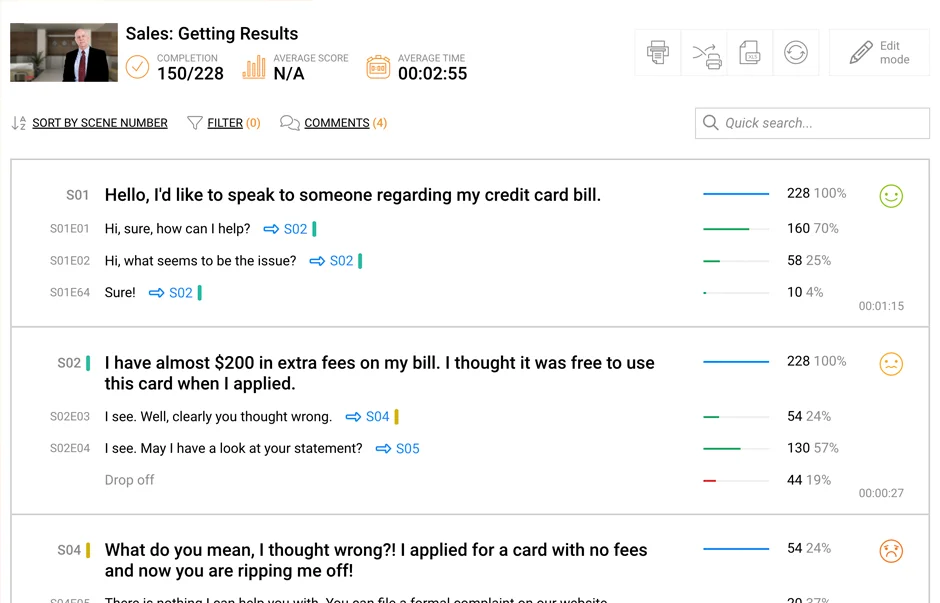
BranchTrack tracks the choices learners make, the paths they take, and the moments where teams hesitate. That is the data you need to improve training.
White papers
Field guides and research summaries for making the case inside your organization. Free — just tell us where to send future editions.
Why practice beats page-turning on every metric that matters: engagement, retention, time-to-competence, and cost per learner.
Enter your email below to download Download PDFChallenge, Choice, Consequence — a practical guide to designing decision-based scenarios that feel real and measure judgment.
Enter your email below to download Download PDFHow L&D teams are swapping awkward classroom roleplay for repeatable AI conversation practice — and what the data shows.
Enter your email below to download Download PDFNo spam — we'll only email you when new papers drop.